
Moving to the Interior in Winter: Coquihalla Chain Rules and How They Affect Your Move Date

You picked the house, signed the papers, and set a moving date in January. Then a friend asks, “Have you checked the Coquihalla forecast?” For many families who book Surrey to Kamloops movers, that is the moment winter stops being a season and becomes part of the moving plan.

The drive from Surrey to Kamloops takes about four hours on a clear day. In winter, it can take six, or the road can close for hours. The same is true for anyone moving to the Okanagan in winter, because most of those trips use the same mountain highway before turning toward Kelowna or Vernon.

This guide explains the winter rules that apply to moving trucks, how chain-ups work, and how they change your move date. It is written from the view of crews who drive this route all winter, not from a desk.

Whether you are comparing long distance movers Surrey BC offers or planning to drive yourself, these rules shape your timeline.

This guide also shows what to ask when you get a moving quote, so winter risks are covered before you book.

If you are coming the other way, the same rules apply. Good Kamloops to Surrey movers plan the return trip over the summit with the same care.

Why Does Winter Change Long Distance Moving in BC?

Most long-distance moves out of the Lower Mainland cross at least one mountain pass. The Coquihalla, or Highway 5, climbs to about 1,240 metres at the summit. Grades reach up to 8 percent in places. Snow can fall there when Surrey has only light rain.

The province treats this road seriously. Winter tire and chain rules apply on the Coquihalla from October 1 to April 30. That is a full seven months, not just December and January.

Weather also changes the timeline. Snowfall, avalanche control, and crashes can close sections of the highway for hours. A moving truck caught behind a closure cannot simply take a short detour. The other routes, such as Highway 3 or the Fraser Canyon, add hours and have their own winter risks.

What Are the Winter Tire Rules BC Moving Truck Drivers Must Follow?

The winter tire rules BC moving truck drivers follow depend on the size of the truck. This is where many people get confused, especially if they plan to rent a truck themselves.

  • Cars and small rental trucks. Passenger vehicles and light trucks need winter tires on designated highways like the Coquihalla. Tires must show the mountain snowflake symbol or the M+S symbol and have at least 3.5 mm of tread.
  • Trucks from 5,000 kg to 11,794 kg. These commercial trucks must carry chains or an approved traction device, unless they run winter-rated tires with the right symbol. Many standard five-ton moving trucks fall in this range.
  • Trucks 11,794 kg and over. Larger moving trucks and tractor-trailers must carry steel chains on most major highways from October 1 to April 30.

Most families never think about truck weight. A professional crew does, because it decides what gear must be on board before the truck leaves the yard in Surrey.

How Do Chain-Up Rules Commercial Vehicle BC Drivers Face Work on the Coquihalla?

The chain-up rules commercial vehicles BC drivers face go further than just carrying chains. When signs show chain-up is in effect, commercial trucks must stop at a chain-up area and install chains before continuing.

Where Chain-Up Happens

On the Coquihalla, the main chain-up area northbound is at Box Canyon, near the start of the long climb from Hope. There are more chain-up areas along the route, and signs show when each one is active. Crews then remove chains at chain-off areas once the road eases.

How Many Chains a Moving Truck Needs

The number of chained tires depends on the truck’s weight and setup. Smaller commercial trucks need chains on at least two tires. Larger trucks over 11,794 kg must use steel chains, and some configurations need chains on as many as six tires.

What Happens If a Driver Skips It

The fines are real. A commercial driver who fails to chain up during a mandatory chain-up can face a fine of several hundred dollars. More importantly, an unchained truck that spins out can close the highway for everyone.

At Gold Line For Moving, our drivers carry the right chains on every Interior trip from October to April and practise fitting them before the season starts. That habit comes from years as long distance movers Surrey BC families trust on this route. Fitting chains at Box Canyon in the dark is not the time to learn.
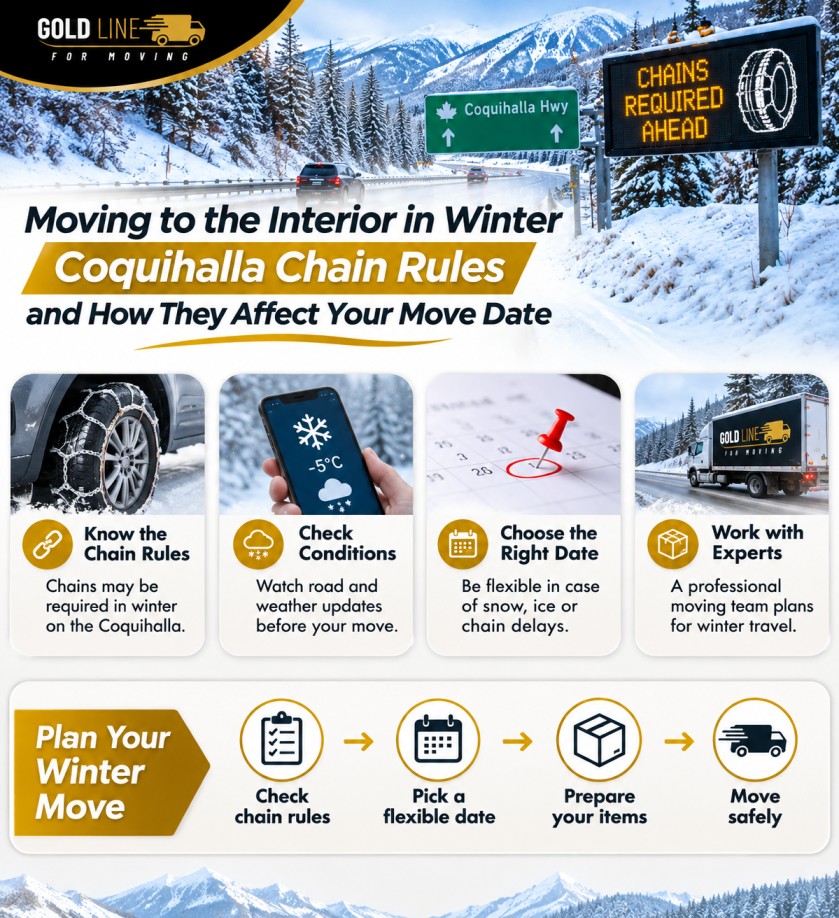
What Should You Know About Coquihalla Winter Driving Moving Day Timing?

Good Coquihalla winter driving moving plans start with the clock. Here is how experienced crews plan the day.

  • Start early, finish in daylight. Winter daylight is short. Crews aim to cross the summit by early afternoon, when roads are often at their best and light is still good.
  • Check DriveBC before leaving. DriveBC shows closures, chain-up status, and road cameras. Crews check it before loading ends and again before leaving Hope.
  • Fuel up in Hope. There is no fuel for about 110 km between Hope and Merritt. A heavy truck climbing in snow burns more fuel than usual.
  • Respect the truck lane rules. Commercial vehicles cannot use the far-left lane on some uphill sections northbound. This slows the climb, so build it into the timeline.

Here is a typical example. A family moved from a Newton townhouse to Aberdeen in Kamloops in late January. Snow was forecast for the summit after 3 pm. The crew loaded the truck the evening before, left Surrey at 6 am, chained up at Box Canyon, and crossed the summit before noon. The family drove behind in their own car with winter tires. Unloading finished by mid-afternoon, before the snow arrived.

How Do Professional Moving Services Plan a Flexible Winter Move Date?

Professional moving services plan winter moves with a backup in mind. The goal is not to promise a fixed delivery time no matter what. The goal is to get your belongings there safely.

Build a Buffer Day

If you can, leave one extra day between the load date and your key or possession date. If the highway closes, the truck can wait safely without leaving you stuck.

Plan Where the Truck Will Wait

Ask your mover what happens if the road closes. A good crew will explain whether the truck waits in Hope, stays overnight, or turns back. Your belongings should stay secure and dry the whole time. Kamloops to Surrey movers plan for the same risk heading south, where the long descent toward Hope can turn icy fast.

Keep Your Own Trip Separate

Do not plan to follow the truck in a car with summer tires. If you drive yourself, your vehicle must meet winter tire rules on the Coquihalla. Pack an emergency kit with warm clothes, water, and snacks.

What Mistakes Do People Make When Moving to the Interior in Winter?

  • Booking a tight closing date. A same-day load and key handover leaves no room for a highway closure. One storm can turn a smooth plan into a missed deadline.
  • Renting a truck without checking rules. Many people do not know their rental truck’s weight class or tire rating. Some end up without chains on a road that requires them.
  • Thinking April is safe. The rules last until April 30 for a reason. Spring snowstorms on the summit are common.
  • Picking the cheapest quote without asking about winter gear. A mover without chains or winter experience may cancel at the last minute or take risks you do not want.

A common misconception is that big trucks handle snow better than cars. Heavy trucks need more distance to stop and can lose traction on steep grades. That is exactly why the chain rules exist.

Which Questions Should You Ask Residential Moving Companies Before Booking?

Not all residential moving companies run winter mountain routes often. Ask these questions before you sign.

  • How often do you drive the Coquihalla in winter? A specific answer, such as “every week from November to March,” builds trust.
  • What chains and tires are on your trucks? The crew should explain their gear without guessing.
  • What happens if the highway closes? Ask about waiting time, overnight stops and how they keep you updated.
  • Is there a backup date in the plan? Good movers will suggest one rather than wait for you to ask.

When you get a moving quote for a winter trip, ask for these answers in writing. Clear answers now prevent stress later.

Final Thoughts on Moving to the Okanagan in Winter

Moving to the Okanagan in winter, or to Kamloops, is very doable with the right plan. Know the rules, watch the weather, start early, and leave room for delays.

Choose Surrey to Kamloops movers who carry the right chains, know the chain-up areas and plan your date around the forecast.

If you are heading back to the coast, experienced Kamloops to Surrey movers should offer the same winter planning in reverse.

Pick long distance movers Surrey BC families recommend for real mountain experience, not just a low price.

When you are ready, Gold Line For Moving can help you plan a safe winter move with a sensible buffer day. Get a moving quote early, especially for December through March, so your date and your crew are locked in before the snow does the planning for you.

FAQs

When do winter tire and chain rules apply on the Coquihalla?

The rules apply from October 1 to April 30 on the Coquihalla and other mountain passes in BC. Some lower highways end on March 31, but the Coquihalla runs the full seven months because of its height and snowfall. Passenger vehicles need proper winter tires during this period. Commercial trucks over 5,000 kg must carry chains or approved traction devices, and larger trucks must carry steel chains on most major highways.

Does a rental moving truck need chains on the Coquihalla?

It depends on the truck’s licensed weight. Most small rental trucks count as light vehicles and need winter tires rather than chains. Larger rental trucks between 5,000 kg and 11,794 kg must carry chains or traction devices unless they have winter-rated tires with the correct symbol. Before you leave, check the truck’s paperwork, ask the rental company about its tires, and carry chains if there is any doubt.

What happens to my move if the Coquihalla closes?

If the highway closes, the truck will usually wait at a safe spot, such as Hope or Merritt, until it reopens. Some closures last an hour, while others last most of a day. A good mover will keep you updated by phone and protect your belongings while they wait. This is why a buffer day between loading and your key date is so useful during winter months.

Is it better to move to Kamloops in winter or wait for spring?

Winter moves can work very well and are often easier to book than summer moves. The key is planning. If your dates are flexible, early fall or late spring may reduce weather risk. If you must move in winter, start early in the day, leave a buffer day, and choose a crew with mountain experience. Many families move safely every winter with the right preparation and a realistic timeline.

How far ahead should I book Surrey to Kamloops movers in winter?

Book at least three to four weeks ahead for a winter move, and longer around holidays and month-end dates. Early booking gives you a better choice of dates and lets the mover plan around the forecast. It also gives you time to arrange a buffer day with your realtor or landlord. Ask the mover to confirm their winter route plan, chain gear, and backup options when you book.


Hourly vs Flat Rate Movers in Surrey: Which Pricing Model Protects You

Two quotes land in your inbox for the same move. One says a set hourly rate for a three-person crew. The other gives one fixed number for the whole job. Which one is the better deal? Most people asking for a moving quote Surrey companies send face this exact choice, and the answer is not always obvious.

The choice between hourly vs flat rate movers is really about risk. With one model, you carry the risk if the move runs long. With the other, the mover carries it. Knowing who carries the risk tells you which quote truly protects you.

This guide explains both models in plain words. It shows when each one works best, the fine print to check, and the mistakes that turn a fair price into a nasty surprise. It draws on years of work as movers Surrey BC households call for local and long-distance moves.

Whether you compare three companies or just want to understand one moving estimate BC movers have sent you, the steps below will help you read it with confidence.

Why Do Movers Use Different Pricing Models?

Every move is a mix of known and unknown work. A mover knows how many beds and boxes you have. They do not know if a strata elevator will break, if traffic on Highway 1 will stall, or if half the boxes are still unpacked when the crew arrives.

Hourly pricing passes those unknowns to you. Flat rate pricing asks the mover to price them in up front. Both are honest models when used properly. The trouble starts when a customer does not know which model they agreed to, or what the price leaves out.

Local moves in the Lower Mainland are most often priced by the hour. Long-distance moves, such as Surrey to Kelowna or Vancouver Island, are more often flat rate or based on weight and distance.

Hourly Moving Rates Explained, What Are You Paying For?

Here are hourly moving rates explained the way we explain them on the phone. You pay a set rate per hour for a truck and a crew of a certain size. The clock starts and stops at agreed points.

  • Minimum hours. Most hourly movers charge a minimum, often two or three hours. A small studio move may finish faster, but you still pay the minimum.
  • Travel time. Some companies charge a flat travel fee. Others bill time from their yard to your door and back. Ask which applies, because it changes the total.
  • Billing increments. After the minimum, many movers bill in 15 or 30-minute blocks. Fifteen-minute billing is fairer for you.
  • Extras. Stairs, long carries, heavy items like pianos and packing materials may cost extra. A clear quote lists these up front.

Hourly pricing rewards preparation. If every box is packed, taped and labelled, and parking is close to the door, an hourly move can come in well under a flat price.

How Does a Flat Rate Moving Quote Work?

A flat rate moving quote gives you one price for an agreed list of items and services. The mover studies your inventory, often through a video walk-through or in-home visit, and prices the full job.

The big benefit is certainty. If traffic is bad or the elevator is slow, the price stays the same. You know your number before moving day.

The catch is the inventory list. A flat price only covers what is on the list. If you add a garage full of tools on moving day, or the boxes are not packed as promised, the mover can adjust the price. Always check the quote for the words that explain when the price can change.

At Gold Line For Moving, we walk through the inventory with each customer before we confirm any fixed price. That habit comes from years as movers Surrey BC homeowners call when a cheap quote from somewhere else suddenly grew on moving day. A list that is checked together protects both sides.

What Is a Binding Moving Estimate, and How Is It Different?

A binding moving estimate is a written promise that the price will not change, as long as the job matches what was described. It works much like a flat rate. A non-binding estimate is only a best guess, and the final bill can go up or down.

Many people assume every estimate is binding. It is not. Look for clear wording such as “fixed price” or “binding” in the written quote. If the document says “estimate only” or “subject to actual time,” treat it as a guide, not a promise.

Also ask what happens if the job grows. A fair binding estimate explains how extra items or services are priced, so there are no arguments later.

Which Model Fits Your Move? Three Surrey Examples

Real moves make the choice clearer. Here are three typical cases we see.

A One-Bedroom Condo in Whalley

Sam is moving a one-bedroom condo to another building nearby. Everything is packed, both buildings have booked elevators, and the drive is 15 minutes. This is a great fit for hourly pricing. The job is small, predictable and short. A flat price would likely include a buffer Sam does not need.

A Four-Bedroom House in South Surrey

The Patels are moving a four-bedroom home with a garage, a basement suite and a piano to Langley. There are many moving parts and plenty of chances for delays. A flat rate gives them a firm number and moves the risk of a long day to the mover.

A Long-Distance Move to Kelowna

A family is moving from Fleetwood to Kelowna. Long drives, mountain weather and fuel make hourly billing risky. Most long-distance moves use a flat or binding price based on inventory and distance. This keeps the family safe from delays on the Coquihalla.

How Can a Moving Cost Calculator Help Before You Get a Quote?

A moving cost calculator gives you a rough idea of volume before you talk to a mover. You list your furniture and boxes, and it estimates the space your items need. This helps you understand what size truck and crew make sense.

Treat the result as a starting point, not a final price. Calculators cannot see your stairs, your parking or how ready you are. Use it to prepare, then get a real moving estimate BC crews confirm with a walk-through or video call.

What Mistakes Do People Make When Comparing a Moving Estimate?

  • Comparing hourly and flat prices directly. An hourly quote shows a rate, not a total. Ask the hourly mover for a realistic time range so you can compare fairly.
  • Ignoring the crew size. Two movers at a lower hourly rate can take far longer than three movers. The cheaper rate can end up costing more.
  • Leaving items off the inventory. Forgetting the shed, storage locker or patio set can change a flat price on the day.
  • Not checking insurance and coverage. Ask about valuation coverage for your belongings and whether the company holds WorkSafeBC coverage for its crew.
  • Skipping the written quote. A phone price is easy to forget. Ask for everything in writing.

A common misconception is that flat rate always costs more. It sometimes includes a small buffer, but for complex moves it often ends up lower than an hourly job that runs long.

When Should You Book a Move to Get the Best Quote?

Timing affects both price and choice. Here are the pro tips we give every caller.

  • Book two to four weeks ahead. Month-end dates in Surrey fill fast. Booking early gives you more crew options and more time to compare.
  • Choose mid-month or mid-week if you can. Demand is lower, and some movers offer better rates or more flexible start times.
  • Be honest about your inventory. A complete list is the best way to get an accurate flat price or hourly time range.
  • Pack before the crew arrives. Every hour the crew spends packing loose items is an hour you pay for on an hourly move.

When you ask for a moving quote Surrey movers can stand behind, share photos or a short video of each room. It makes the number far more accurate.

Final Thoughts on Hourly vs Flat Rate Movers

There is no single winner in the hourly vs flat rate movers debate. Hourly works well for small, well-prepared local moves. Flat rate protects you on larger, complex or long-distance moves.

Always get a written moving quote Surrey companies are willing to explain line by line.

Compare crew size, minimums, travel time and what changes the price. Choose movers Surrey BC families recommend for clear answers, not just low numbers.

When you are ready, Gold Line For Moving can walk you through both options and help you pick the one that fits your move. A clear moving estimate BC homeowners can trust is the first step to a calm moving day.

FAQs About Hourly and Flat Rate Moving Quotes

Is hourly or flat rate cheaper for a small local move in Surrey?

For a small, well-prepared local move, hourly is often cheaper. A studio or one-bedroom move with everything packed, close parking and a short drive can finish quickly, so you only pay for the time used. Watch for minimum hours and travel charges, as these can make a short job cost more than expected. Ask the mover for a realistic time range so you can compare it against any flat price.

Can a flat rate moving quote change on moving day?

Yes, but only in specific cases. A flat price covers the inventory and services listed in the quote. If you add items, the boxes are not packed as agreed, or access is very different from what was described, the mover can adjust the price. A fair mover explains these terms in writing before you book. Read that section closely and update your list if anything changes before moving day.

What should a written moving quote include?

A good written quote should list the crew size, truck size, pricing model and any minimum hours. It should explain travel charges, billing increments and extra costs such as stairs, long carries, heavy items or packing materials. For flat or binding quotes, it should include the inventory list and the conditions for price changes. It should also mention valuation coverage, the company’s contact details and the moving date and time.

How accurate is an online moving cost calculator?

An online calculator is good for planning, but it is not a final price. It estimates the volume of your items based on what you enter. It cannot see stairs, elevators, long walks to the truck or unpacked rooms. Many people also forget items like garage tools or storage lockers. Use the calculator to get a sense of truck size, then ask for a video walk-through or in-home estimate for an accurate number.

How far ahead should I book a move in Surrey?

Book at least two to four weeks ahead for most local moves, and longer for summer or month-end dates. The last few days of each month are the busiest in Surrey, as leases and home sales often end then. Booking early gives you time to compare quotes, check reviews and confirm details such as elevator bookings. For long-distance moves, booking four to six weeks ahead is safer.

How a Moving Truck Gets From Surrey to Vancouver Island: Ferry Booking Explained?

Most people picture a long-distance move as one long drive. A move to the Island is different. Halfway through, your whole household rolls onto a ship. Families who hire Surrey to Vancouver Island movers often ask us the same thing first. How does the truck actually get across the water?

The answer is simple once you see the steps. The truck drives to a BC Ferries terminal, checks in, sails across the Strait of Georgia and drives off on the other side. The hard part is the planning before that day. Booking the moving truck ferry to Vancouver Island at the right time decides whether your move runs smoothly or stalls in a terminal lane.

This guide walks through the full journey, from your Surrey driveway to your new Island doorstep. It covers routes, reservations, check-in, banned items and the mistakes that cost people a full day.

If you plan a move to Victoria in particular, the details below also show what good Surrey to Victoria movers handle for you.

Moving back to the mainland instead? Good Vancouver Island to Surrey movers follow the same ferry steps in reverse, so this guide works both ways.

Many families now book movers online Surrey companies offer before they even check ferry times. That works well, as long as the sailing gets booked right after.

Why Do Long Distance Movers Treat Island Moves Differently?

A move from Surrey to Kelowna follows the highway the whole way. A move to the Island depends on a ferry schedule, deck space and weather on the water. You cannot simply leave earlier to beat traffic.

Space on the vehicle deck is limited. Tall vehicles like moving trucks often load on a separate deck or lane, and that space fills fast on summer weekends, long weekends and month-end dates. A truck without a booking may wait for several sailings.

There is also a cost difference. BC Ferries charges larger and heavier vehicles more than a standard car. Trucks registered over 5,500 kg gross vehicle weight pay commercial rates, which are based on length. A big moving truck costs more to sail than most people expect.

Which Ferry Route Works Best for a Moving Truck?

There are three main routes between the Lower Mainland and Vancouver Island. Each one suits a different destination.

RouteIsland TerminalBest ForApprox. Crossing
Tsawwassen to Swartz BayNear Sidney, north of VictoriaVictoria, Saanich, Langford, SookeAbout 1 hour 35 minutes
Tsawwassen to Duke PointSouth NanaimoNanaimo, Ladysmith, Parksville, Comox ValleyAbout 2 hours
Horseshoe Bay to Departure BayCentral NanaimoSome Nanaimo movesAbout 1 hour 40 minutes

From Surrey, Tsawwassen is the natural choice. It sits about 30 to 40 minutes away by road, outside rush hour. Horseshoe Bay means crossing Vancouver and the Lions Gate or Second Narrows bridges with a loaded truck, which adds time and risk. Most Surrey to Victoria movers choose Tsawwassen for this reason.

For Nanaimo moves, many crews prefer Duke Point. The terminal handles commercial traffic well and avoids tight downtown streets.

How Does a BC Ferries Moving Truck Reservation Work?

A BC Ferries moving truck reservation works much like a car booking, with a few extra details. You need the truck’s length, height and registered weight. These numbers decide the fare class and where the truck loads.

  • Standard vehicles. Smaller rental trucks under 5,500 kg can usually book online like a normal vehicle. The fare rises once the length goes past the standard limit, so measure the truck, not just the box.
  • Commercial vehicles. Heavier trucks book under commercial rates. BC Ferries lets many commercial vehicle types book online, and oversize loads need a phone booking through 1-888-BC FERRY.
  • Timing. Book as soon as your move date is firm. Summer, Fridays and the last few days of each month fill first. A reservation is the only reliable way to secure a set sailing for a tall truck.

Professional long distance movers who cross often know which sailings suit large trucks. They also know how much buffer to leave between the last box loaded in Surrey and the check-in deadline.

What Should You Expect on a Ferry With Moving Truck Booking?

A ferry with moving truck booking feels different from a normal car trip. Here is what the day looks like.

Check-In and Measuring

Arrive early. Booked vehicles must check in before a set cut-off, and large trucks may go to a separate lane. Staff may measure a borderline truck to confirm its fare class. Missing the cut-off can cancel your booking and push you onto standby.

Loading and the Crossing

Tall vehicles often load onto a separate deck or into a set lane. Drivers must leave the vehicle deck during the sailing on most routes. Keep your phone, wallet, medication and pet supplies with you, not in the cab.

How Do Vancouver Island Moving Services Handle Arrival?

Once the ship docks, the truck drives off and heads straight to your new home. On a Swartz Bay arrival, a Victoria address is often 30 to 45 minutes away. Plan for the crew to start unloading soon after.

At Gold Line For Moving, our crews plan the Surrey load around the sailing, not the other way round. We work backwards from check-in time, add a traffic buffer for Highway 17, and only then set the start time. That habit comes from years as Surrey to Vancouver Island movers who have watched trucks miss sailings by ten minutes.

What Items Cannot Go on the Ferry in a Moving Truck?

This is the step most people forget. BC Ferries treats many common household items as dangerous goods. You must declare them, and some cannot travel on passenger sailings at all.

  • Fuel and propane. BBQ propane tanks, gas cans and camping fuel count as dangerous goods. Empty and purge them, or give them away before moving day.
  • Small engines. Lawnmowers, chainsaws and outboard motors with fuel in the tank need special care. Drain them fully before packing.
  • Chemicals. Paint thinners, pool chemicals and aerosol cans in bulk can also cause problems. Use them up or dispose of them at a Surrey drop-off depot.

Failing to declare dangerous goods is an offence under Canadian law. A good moving crew will give you a clear list at booking so nothing gets missed.

What Is the Best Way to Plan How to Move to Vancouver Island?

If you are working out how to move to Vancouver Island for the first time, use this simple order.

  • Choose your route first. Your Island address decides the terminal. Victoria points to Swartz Bay, while Nanaimo and points north suit Duke Point.
  • Lock the date, then book the sailing. Do this weeks ahead, not days. When you book movers online Surrey crews offer, share your Island address and preferred sailing in the same form.
  • Clear out dangerous goods. Start two weeks before. Leftover propane and paint take time to deal with.
  • Pack a ferry bag. Keep snacks, chargers, documents and pet items in your own car. You will not reach the truck once it loads.
  • Plan your own crossing. If you drive your car, book it on the same or an earlier sailing. Arriving before the truck lets you open the door for the crew.

Here is a typical example. A family moved from a Fleetwood townhouse to a home in Langford in July. Their crew loaded by 9:30 am and booked a 1 pm sailing from Tsawwassen. The family drove over on the 11 am sailing, picked up keys and met the truck at the door. Unloading finished before dinner.

What Mistakes Should a Surrey Moving Company Help You Avoid?

  • Not booking the sailing. Standby with a tall truck on a summer Friday can mean a wait of several sailings. Crew hours keep running the whole time.
  • Guessing the truck size. A truck booked as a standard vehicle that turns out longer or heavier may face a different fare or deck space problem at check-in.
  • Forgetting the return trip. The truck must also sail back. Experienced Vancouver Island to Surrey movers and mainland crews alike should show ferry costs both ways in the quote.
  • Ignoring weather. High winds can cancel sailings, mostly in winter. Leave a flexible day in your plan when you can.

A common misconception is that ferry costs are small. For a large truck plus a car, the ferry can add a few hundred dollars to the move. Ask your mover to list it as a separate line item.

Final Thoughts on the Moving Truck Ferry to Vancouver Island

The moving truck ferry to Vancouver Island is not a hurdle when you plan it early. Pick the right route, book the sailing, clear out dangerous goods and build in time.

Choose Surrey to Vancouver Island movers who explain the ferry plan in plain words before you sign.

If Victoria is your destination, experienced Surrey to Victoria movers will match the Swartz Bay schedule to your key pickup time.

Heading back to the mainland? Vancouver Island to Surrey movers should book the return sailing as early as any outbound one.

When you are ready, Gold Line For Moving can build your load time around a confirmed sailing. You can book movers online Surrey families trust and get a clear quote that shows every ferry cost up front.

FAQs About Taking a Moving Truck on BC Ferries

Do I need a reservation to take a moving truck on BC Ferries?

A reservation is not always required, but it is strongly recommended for any moving truck. Tall vehicles compete for limited deck space, and busy sailings can fill hours ahead. Without a booking, your truck may wait on standby for one or more sailings while crew hours keep adding up. Book as soon as your moving date is firm, and give BC Ferries the correct truck length, height and registered weight.

How much does it cost to take a moving truck on the ferry?

The cost depends on the truck’s size and registered weight. Smaller rental trucks often pay a standard vehicle fare, plus extra for length beyond the standard limit. Trucks registered over 5,500 kg pay commercial rates based on length, which can cost noticeably more. You also pay for the driver and any passengers. Fares change, so check the current BC Ferries fare tables and ask your mover to show ferry costs both ways.

Which terminal should I use when moving from Surrey to Victoria?

For most moves from Surrey to Victoria, use the Tsawwassen to Swartz Bay route. Tsawwassen is close to Surrey and avoids crossing Vancouver with a loaded truck. Swartz Bay sits near Sidney, and most Greater Victoria addresses are 30 to 45 minutes away. Book the sailing early, plan your own car on the same or an earlier ferry, and keep keys and documents with you during the crossing.

Can I pack propane tanks or gas cans in my moving truck?

No, you should not pack them without following BC Ferries dangerous goods rules. Propane tanks, gas cans, camping fuel and fuelled engines count as dangerous goods. You must declare them, and many cannot travel on regular passenger sailings. The simplest option is to empty, purge or give these items away before moving day. Your mover can share a full list of restricted items during the booking call.

What happens if the ferry sailing is cancelled on moving day?

Cancellations usually happen because of high winds or mechanical problems. BC Ferries will often move booked customers to the next available sailing. Your crew will wait with the truck, so ask your mover in advance how they handle delay time and overnight holds. If you move in winter, keep a flexible day in your plan and avoid tight key handover times on the Island side.

Moving in the Rain in Surrey: How Movers Keep Furniture and Floors Dry

Rain on moving day is not bad luck in Surrey. It is the normal forecast for half the year. Even after you book residential movers Surrey families trust, one worry stays. Will your sofa, mattress and hardwood floors survive a wet November morning?

The short answer is yes, with the right plan. We have watched crews load full four-bedroom homes in steady downpours without one damp box. The difference comes from preparation, not luck. Good home movers Surrey residents hire treat rain as a normal working condition, not an emergency.

This guide explains exactly how moving in the rain works when professionals handle it. You will learn what gets damaged, how crews prevent it, and what you can do at home before the truck arrives.

We also cover the mistakes we see every wet season. These details help you judge which packers and movers Surrey homeowners can actually rely on when the sky turns grey.

Finally, you will know which questions to ask when you request a free moving estimate Surrey companies offer. A few smart questions at that stage save a lot of stress later.

Why Is Moving in the Rain So Common in Surrey, BC?

Surrey sits in the Lower Mainland, where Pacific storms roll in from October through April. November is often the wettest month of the year. Atmospheric rivers can drop heavy rain for days, as many residents remember from the floods of November 2021.

Most people cannot shift their move to July. Leases end on the first of the month. Home sales close on fixed dates. School terms and new jobs do not wait for sunshine. So moving during rainy season BC is less a choice and more a reality for thousands of households each year.

Rain here also tends to be steady rather than short. A Fleetwood move might face light drizzle all day. A South Surrey move might get a sudden heavy burst at noon. Skilled crews plan for both patterns.

What Do House Movers Worry About Most When It Rains?

Experienced house movers know water damage rarely comes from one big soaking. It builds up from small exposures across dozens of trips between the door and the truck. These are the main risks we watch for.

  • Upholstered furniture. Sofas, armchairs and mattresses absorb water fast. A damp mattress sealed inside a truck for six hours can develop a musty smell and even mould spots within days.
  • Wood furniture. Solid wood and veneer can swell, warp or show white water rings. Flat-pack pieces made from particleboard can puff up at the edges and never return to shape.
  • Cardboard boxes. Wet cardboard loses most of its strength. A box of books with a soaked bottom can split open in the middle of a lift.
  • Electronics. TVs, computers and gaming consoles do not handle moisture well. Condensation inside a cold truck is a hidden risk that many people forget.
  • Floors. Muddy boots and wet dolly wheels can scratch hardwood, stain carpet and leave slippery patches on tile. Floors at both the old home and the new home face this risk.

How Does a Moving Company Protect Furniture from Rain When Moving?

A reliable moving company builds rain protection into every single step. It does not wait to react when the first drops fall. Here is how a well-run crew handles the job.

Wrap First, Then Wrap Again

Crews wrap upholstered pieces in thick moving blankets, then add a layer of stretch plastic wrap over the top. The blanket protects against bumps. The plastic sheds water. Mattresses go into sealed plastic mattress bags before they leave the bedroom.

For wood furniture, the order matters. Crews place the blanket against the wood first. Plastic wrap directly on wood can trap moisture and leave marks, especially on older finishes.

Build a Dry Path to the Truck

The best crews cut the distance furniture travels in open rain. They back the truck as close to the door as the driveway allows. In townhouse complexes in Guildford or Newton, trucks often park further away. There, crews may set up a pop-up canopy or tarp between the door and the ramp.

Some crews also lay a rubber mat or tarp on the truck ramp. This keeps the ramp less slippery and stops dirty water from splashing onto wrapped items.

Load the Truck with Rain in Mind

Smart loading keeps the most sensitive items deep inside the truck, away from the door. Mattresses, electronics and upholstered pieces go in first. Plastic bins, patio furniture and garden tools go near the back, where a little moisture does less harm.

Crews also keep the truck door partly closed between trips during heavy rain. This simple habit stops wind from blowing water inside.

At Gold Line For Moving, our crews carry extra blankets, stretch wrap, mattress bags and floor runners on every truck from October to April. We learned this from years of working as residential movers Surrey families call when the forecast looks grim. Running out of wrap halfway through a wet move is a mistake you only make once.

How Do Home Moving Services Keep Your Floors Dry and Clean?

Floors often suffer more than furniture on a wet day. Good home moving services protect the floors at both properties, not just the one you are leaving.

Floor Runners and Door Mats

Crews roll out heavy-duty floor runners from the front door along the main carrying path. Adhesive carpet film protects carpet on stairs and hallways. Large absorbent mats at each entry trap water before it reaches the house.

Clean Boots and Dry Wheels

Crew members wipe their boots at every entry. Some switch to indoor shoe covers for long carries inside. Dollies and hand trucks get a quick towel wipe before they roll across finished floors.

Here is a real-world style example. Last winter, one of our crews moved a family from a Cloverdale rancher to a new Panorama Ridge home with fresh white oak floors. It rained for all seven hours. The crew laid runners before carrying a single box and changed the entry mats three times. At the end of the day, the owners found no scratches and no water marks.

What Wet Weather Moving Tips Should You Follow Before Moving Day?

These wet weather moving tips help you work with your crew, not against it. Most take less than an hour and make a real difference.

  • Use plastic bins for key items. Bins handle rain far better than cardboard. Use them for documents, photos, electronics cables and anything you cannot replace.
  • Double-tape box bottoms. Run tape across the bottom seam twice in an H pattern. This keeps boxes strong even if the outside gets a little damp.
  • Bag soft items. Put pillows, bedding and clothes in large plastic bags before they go into boxes. This adds a second barrier against moisture.
  • Set up a dry zone. Clear a space near the entrance of your new home. The crew can drop boxes there while you keep towels and a mop close by.
  • Disconnect electronics early. Unplug TVs and computers the night before. This lets them reach room temperature and reduces condensation risk during the move.

Full packing service adds another layer of protection. When packers and movers Surrey residents hire do the packing, they choose the right box strength and seal every seam properly.

Use this quick table to plan protection for your most common items.

ItemMain Rain RiskBest Protection
MattressAbsorbs water, mould growthSealed plastic mattress bag
Sofa or armchairSoaked fabric, musty smellMoving blanket plus stretch wrap
Wood dresser or tableSwelling, water ringsBlanket first, plastic on top
Cardboard boxesCollapse when wetPlastic bins or double tape and plastic cover
TV and electronicsMoisture and condensationOriginal box or padded carton, loaded deep in truck
FloorsScratches, mud, slipsRunners, entry mats, wiped dolly wheels

What Mistakes Make Moving in the Rain Harder?

Some problems come from habits, not weather. These are the mistakes we see most often.

  • Waiting for the rain to stop. In a Surrey November, it may not stop at all. Delays push the move into early darkness, which adds slip risks and stress.
  • Using old grocery boxes. Thin or reused boxes fail quickly once they absorb moisture. Strong new moving boxes cost little compared with a broken lamp.
  • Packing damp items. Wet patio cushions, umbrellas and rain jackets trap moisture inside boxes. Dry them first or pack them separately in plastic bags.
  • Forgetting the new home. People protect the floors they are leaving to get their deposit back. They then let mud into the new home they actually care about.

One common misconception is that plastic wrap alone is enough. It is not. Plastic without padding offers no protection from bumps, and on wood it can trap moisture against the finish.

Which Pro Tips Help Most on a Rainy Moving Day?

Experienced home movers Surrey families recommend often share the same small habits. These pro tips come from many wet moves across the city.

  • Ask about the rain kit early. When you book a free moving estimate Surrey crews provide, ask what rain gear comes on the truck. A confident, specific answer tells you a lot about their experience.
  • Book a morning start. Morning moves leave more daylight for careful work. They also leave room to slow down during heavy bursts without running late.
  • Check parking ahead. Reserve the closest spot to your door, or ask your strata about loading zones. Every metre of open ground adds rain exposure.
  • Unwrap and air out quickly. Remove plastic wrap from furniture within 24 hours. This lets trapped moisture escape before it causes smells or mould.
  • Pack a first-night bin. Keep towels, a change of clothes, bedding and a kettle in one sealed bin. You will thank yourself after a long wet day.

Final Thoughts on Moving in the Rain in Surrey

Here in the Lower Mainland, moving in the rain is simply part of life. You cannot control the weather, but you can control the preparation.

The right residential movers Surrey homeowners hire will wrap furniture in layers, build a dry path to the truck and protect floors at both homes.

Choose home movers Surrey residents recommend for real wet-weather experience, not just low prices. Ask direct questions and watch for clear answers.

If packing feels like too much, packers and movers Surrey families use can handle it with stronger materials and better sealing.

When you are ready to plan, Gold Line For Moving can walk you through a rain-ready moving plan. Request a free moving estimate Surrey residents can count on, and move with confidence, whatever the forecast says.

FAQs About Moving in the Rain in Surrey

Do movers in Surrey still work when it is raining heavily?

Yes, most professional crews in Surrey work through rain because it is so common here. They bring blankets, stretch wrap, mattress bags, floor runners and tarps as standard gear. The only time a crew should pause is during unsafe conditions, such as flooding, high winds or icy ramps. A good crew will talk with you openly if the weather becomes truly dangerous rather than pushing ahead and risking injury or damage.

How can I protect furniture from rain when moving if I do part of the move myself?

Start with padding, then add plastic. Wrap each piece in a moving blanket or thick old duvet, then cover it with stretch wrap or a heavy plastic sheet. Never put plastic straight onto wood, because it can trap moisture and mark the finish. Keep your carrying path short, park as close to the door as possible, and load soft items like mattresses deep inside the vehicle, away from the open door.

Will rain make my move take longer or cost more?

Rain can add some time, usually because crews wrap items more carefully and change entry mats more often. For an average home, that might mean an extra 30 to 60 minutes, depending on parking distance and how much is pre-packed. You can reduce this by packing fully before the crew arrives, using plastic bins and reserving close parking. Ask your mover during the estimate how they handle rain and whether they bill hourly.

What should I do if something gets wet during the move?

Act quickly. Unwrap the item, wipe off surface water with a dry towel and let it air out in a warm, ventilated room. For upholstery and mattresses, use a fan and avoid direct high heat, which can shrink fabric. For wood, dry it gently and check for swelling over the next day. Take photos straight away and tell your moving company, since many movers offer valuation coverage for damage during the move.

Is it better to postpone a move during an atmospheric river warning?

It depends on the warning level and your local roads. Normal heavy rain is manageable for an experienced crew. However, an atmospheric river can cause flooding, road closures and power outages, especially in low-lying areas. Check Environment Canada alerts and DriveBC road reports a few days before your move. Talk with your mover early about backup dates, and confirm your lease or closing terms allow some flexibility if conditions turn unsafe.